
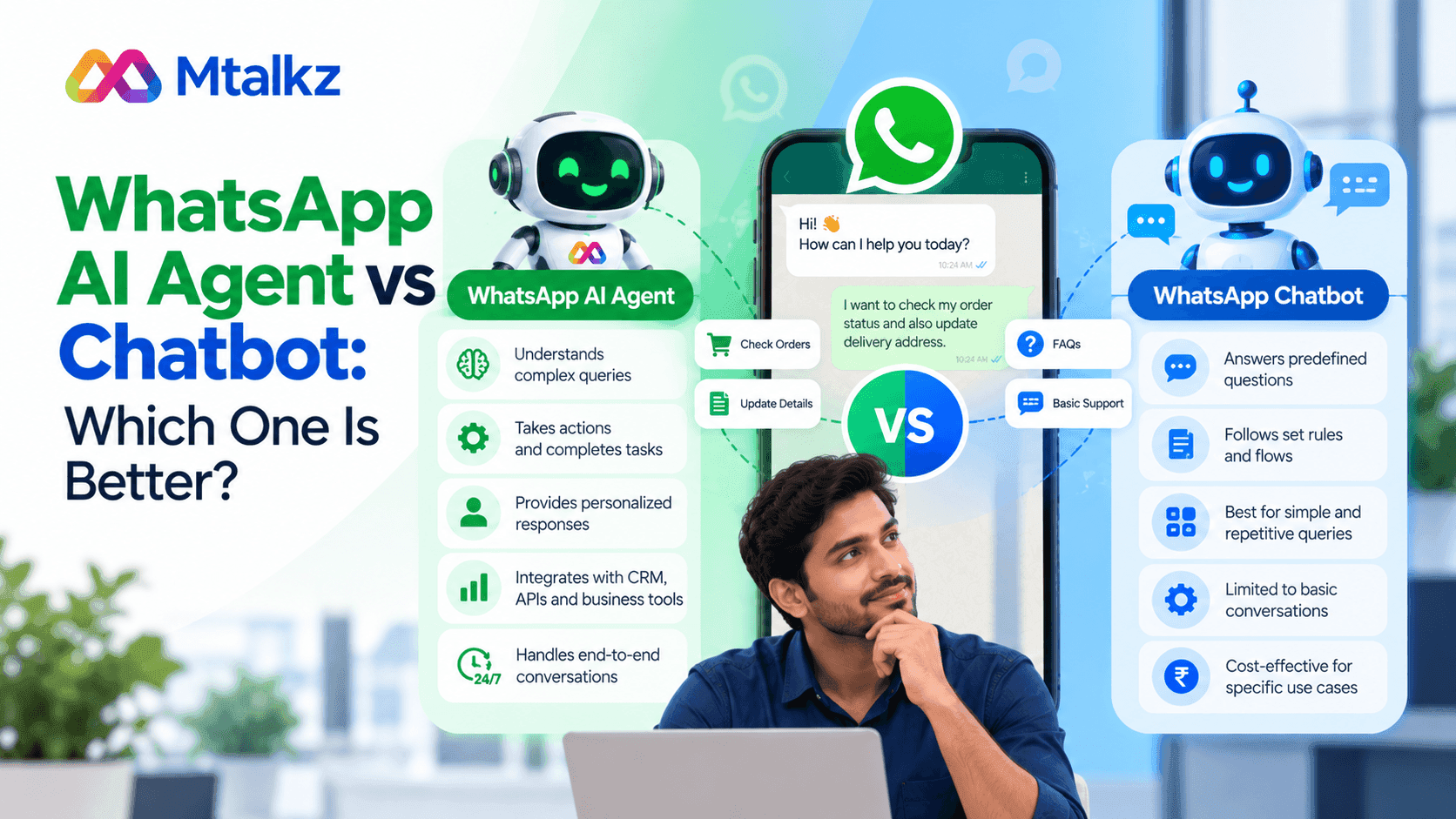
WhatsApp AI Agent vs Chatbot: Which One Is Better?
WhatsApp chatbots follow predefined conversation flows, while AI agents understand intent and context to handle more complex queries.
Abhishek Prakash
•Strategic sales leader with deep focus on customer relationship building and revenue growth. With over two decades of experience at corporates like IBM, Bharti Airtel, and Reliance Jio, driving excellence in enterprise profitability and competitive advantage.
So, which are you connecting your audience to: a WhatsApp AI Agent or a chatbot? Your business requirements will decide which one you choose. WhatsApp chatbots answer users' queries, whereas a WhatsApp AI agent for business understands the objective and can move a conversation towards an outcome.
Let’s consider a scenario to better understand the situation. When a customer messages on WhatsApp at 11:00 PM. They want to check on an order or ask about a policy. In such a case, a chatbot can answer general questions.
But how will you proceed with conversations when customers want to discuss real-time questions and need the system to understand the request and escalate the issue when necessary?
That’s the big difference you need to understand before using any communication channel.
According to the McKinsey State of AI Survey, 28% of businesses spend 10% of their total IT expenses on artificial intelligence. And 60% of companies expect to increase this further.
WhatsApp Chatbot vs AI Agent: What Is the Actual Difference?
When you look at it at the surface level, you will find no difference between a chatbot and an AI Agent. Both answer the customer’s questions, reply to the chat, and automate the customer conversation. However, how they react to your conversation after receiving your queries is what creates the difference. Let’s understand it step by step:
What is a WhatsApp Chatbot, exactly?
A WhatsApp Chatbot is an automated system that works on a predefined pattern of questions and answers. You start a conversation, and the chatbot follows it.
In simple words, a chatbot acts as a menu; you can order only what is mentioned in it. Likewise, you can ask only pre-decided questions.
For example, you send: Hi, I want to know your services.
The chatbot might reply: Sure! Please choose one:
You need to choose an option, and the chatbot will take you to the next step. That’s why a Chatbot is best when you need to ask simple and repetitive questions. You can use it for the following scenarios:
- To share the price of your services
- To know what service your customer is looking for
- To share order status
- To answer frequently asked questions
- To collect leads
What is a WhatsApp Agent meant for
A WhatsApp AI agent is an upgraded version of a WhatsApp chatbot. Powered by a large language model, it reads your messages, understands the intent, and sends a reply accordingly. It doesn't always need the customer to select from a fixed menu.
For example:
You send a message to an AI agent: I bought a purse last week, but it is too small. Can I return it?
AI agents can understand that you want to return your product due to a size issue. If the company connects its AI agent to its order system, it may be able to check the order, see whether the product is eligible for return, and guide you through the process.
A WhatsApp AI Agent can:
- Understand your query even if you use different languages.
- Keep the context across the full conversation and reply to your queries accordingly.
- Extract live data from CRM or order system using API integration.
- Recommend products to you based on your choices and preferences.
- Transfer your conversation to a human if required.
WhatsApp Chatbot vs. AI Agent: Understand the Core Differences
The core difference between these two communication platforms is flexibility. A chatbot follows the pre-designed conversation path, while an AI agent understands what problem you want to solve and takes you to the solution step by step.
By using chatbots, your business can generate up to 5 times more leads than traditional marketing channels. This is because WhatsApp has more than 3 billion monthly active users worldwide.
When you connect your customer support through a WhatsApp chatbot, you can automate conversations and answer common questions. You can capture leads directly within the messaging platform.
Where Do WhatsApp AI Agents Fail?
As we discussed, an AI agent can interpret the context and share its response accordingly. However, it is not suitable for every situation. There are some limitations that limit AI agent performance:
Not able to understand every question:
When a customer asks a question outside the knowledge of an AI agent or provides incomplete information, it will struggle to provide the answer.
High dependency on accurate business data:
AI agents depend on the data you feed them. It can provide incomplete or outdated information if the data is incomplete, outdated, or poorly maintained.
Cannot take every action on its own:
AI agents can understand the request but cannot take the action automatically. If you don’t provide access to your business system to the AI agent, it cannot resolve the problem or provide the solution. Tasks like checking an order, processing a refund, or updating customer information require the right API or system integration.
Demand for human presence to solve complex or sensitive cases:
There is no doubt that some complaints, account issues, or high-impact decisions need human assistance. The AI agent should be programmed for these situations and transfer the conversation to humans when necessary.
Poor setup can affect the customer experience:
You do need to provide clear instructions, relevant business information, and well-designed escalation rules. If you provide unclear instructions, even a capable AI model may provide unhelpful responses.
One thing to keep in mind is that you don’t have to make an AI agent handle every conversation. It should be designed to manage the requests it is programmed for and smoothly hand over the conversation when human support is required.
When Is a WhatsApp Chatbot a Better Choice?
WhatsApp Chatbot is a better choice when you have to answer simple questions or follow a predictable journey. You may not need an AI agent for every conversation.
You can choose a WhatsApp Chatbot in the following ways:
To answer repetitive questions:
A chatbot performs best when you have to answer some general queries related to pricing, services, delivery, business hours, or payment methods without involving your support team.
To continue with a fixed customer journey:
When a customer has to follow basic steps such as picking a service, sharing their details, or booking an appointment, a chatbot can make the process simple and easy to manage.
To capture the lead:
A chatbot works best when you just have to ask for a name, phone number, email, or service requirement and send the details to your sales team.
To get predictable responses:
When you have to share the same approved information with every customer, predefined chatbot responses give you better control over what is communicated.
To take simple decisions:
When you want to perform basic activities such as checking order status, sharing payment instructions, or answering common questions, a chatbot can do the job without the added complexity of an AI agent.
There are some situations where you don’t need an AI agent. When the customer journey is simple, a well-designed WhatsApp chatbot can be faster, easier to manage, and sufficient for the job.
What Should You Choose: Chatbot vs AI Agent
The decision of choosing either a chatbot or an AI agent depends on the type of conversation you want to manage and what you want your WhatsApp communication to handle.
A WhatsApp chatbot is the best option when you have to manage simple, repetitive queries and follow a fixed journey. But an AI agent is good for customer support when you need to manage open-ended questions, offer personalised responses, or expect the system to take action.
At Mtalkz, we help businesses use WhatsApp automation based on their actual communication requirements. You can use a chatbot for straightforward customer journeys and add AI capabilities when conversations require more understanding, context, or automation.
With the right integrations, you can connect AI to your systems to support tasks beyond simply answering questions.
Ready to Automate Your WhatsApp Conversations? We Can Help!
A WhatsApp chatbot and AI agent can make your customer communication easy to manage and simple to access. A chatbot is the best option when you have to lead your customer through a fixed journey and ask simple and repetitive questions. But when your conversations are unpredictable and require context, you should choose an AI agent.
Whether you need a simple WhatsApp chatbot, an AI agent for complex customer queries, or both, we can help you meet your communication requirements. At Mtalkz, we help businesses to build the right automation to smooth their customer conversations.
Talk to our WhatsApp automation experts and find the right solution for your customer conversations.
Contact Us: https://www.mtalkz.com/contact-us
FAQs
Is a WhatsApp AI agent better than a chatbot?
We cannot say that a WhatsApp AI agent is better than a chatbot or a chatbot is better than an AI agent. The efficiency of both communication platforms depends on the conversations you want to manage. A WhatsApp chatbot is suitable for simple and repetitive queries, whereas a WhatsApp AI agent is best for personalised responses or actions.
Can a WhatsApp chatbot use AI?
Yes, a WhatsApp chatbot can use AI to answer customer questions, handle media, and automate tasks. To connect your WhatsApp chatbot to your AI, you need API integration.
Can a WhatsApp AI agent replace a chatbot?
No, a WhatsApp AI agent cannot replace a chatbot completely. Instead, they can work together and manage customer communication more efficiently.
Can a WhatsApp chatbot and AI agent work together?
Yes, you can use both a WhatsApp chatbot and an AI agent together. You can use a chatbot for simple queries and divert more complex conversations to an AI agent or human support team.
What is the pricing for a WhatsApp API AI agent?
There are three factors that determine the WhatsApp API AI agent pricing: Meta’s message cost, subscription fees of a business solution provider (BSP), and AI processing or bot add-on charges.

