
Bulk SMS Campaign Tracking: 7 Key Metrics to Measure
Learn how to track bulk SMS campaign performance using delivery rate, CTR, conversions, opt-outs, replies and ROI, with formulas and practical tips.
Abhishek Prakash
•Strategic sales leader with deep focus on customer relationship building and revenue growth. With over two decades of experience at corporates like IBM, Bharti Airtel, and Reliance Jio, driving excellence in enterprise profitability and competitive advantage.
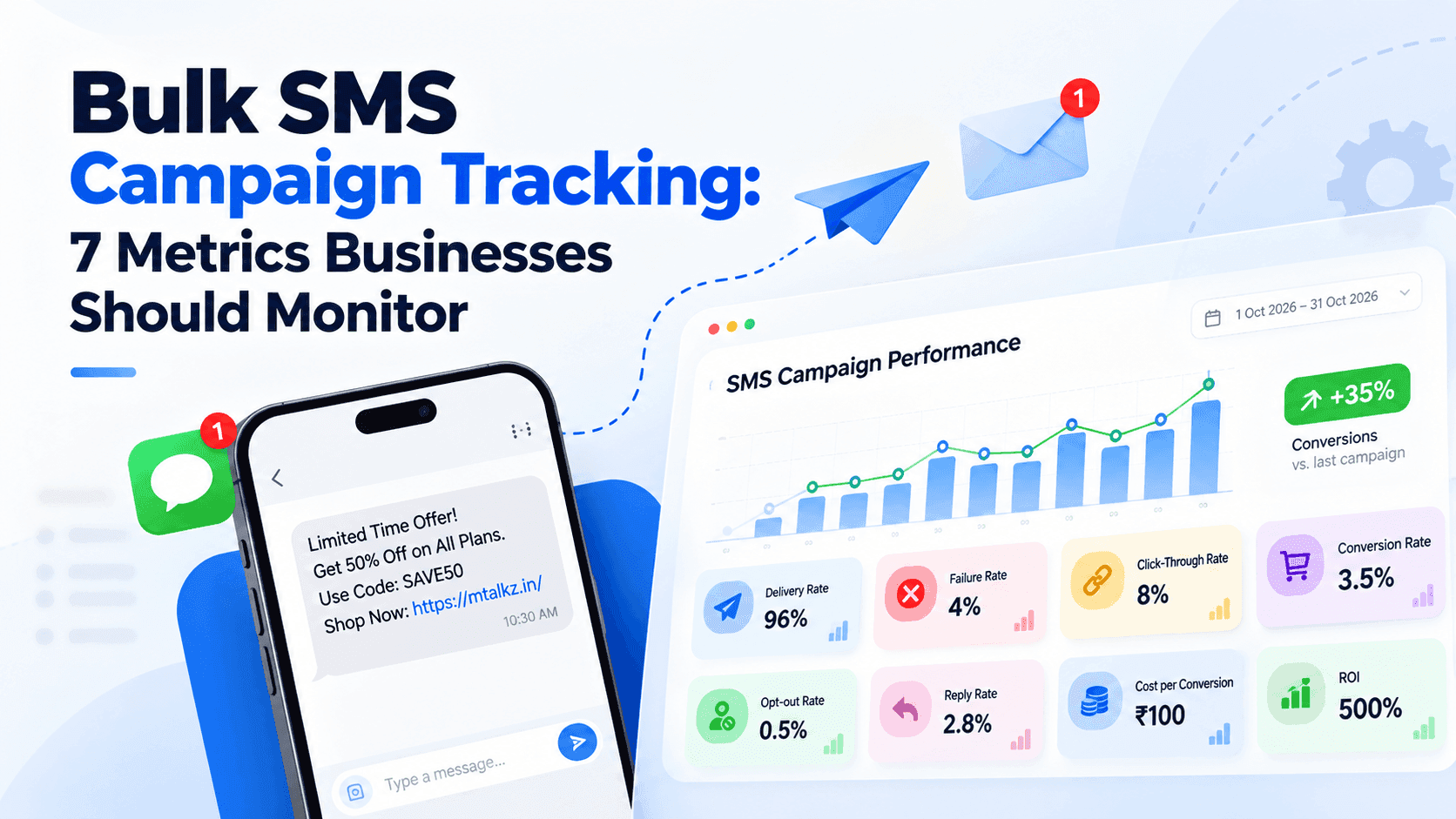
Bulk SMS Campaign Tracking: 7 Metrics Businesses Should Monitor
You sent 50,000 SMS messages last night. This morning, there is no spike in orders and hardly any customer replies. In that case, you might think: Did your bulk SMS campaign work? How do you track a bulk SMS campaign?
The number of messages sent cannot tell you the whole story. Some messages may fail to reach their recipients. Others may be delivered but generate no clicks, replies, bookings, or sales. Without tracking campaign performance, you cannot tell where things went wrong or what needs to improve.
Bulk SMS campaign tracking helps you measure results at every stage, from message delivery to customer action. It shows which parts of your campaign are working, where you may be losing potential customers, and how effectively you are spending your budget.
Let's understand how to measure your campaign performance, calculate key metrics, identify common problems, and improve future SMS campaigns.
Why Tracking a Bulk SMS Campaign Matters
Bulk SMS campaign tracking helps you know the actual figures. At each step, you can either get a new customer or lose a customer. SMS is a direct, fast message, but a single campaign can cost you thousands of rupees. A sent message doesn’t always mean it worked.
A text message can be sent but might not reach the person; if it is reached, then it might never be opened, and if it even gets opened, it might not lead to a sale.
Here’s what bulk SMS tracking helps you with:
- Spend less on weak campaigns: Stop weak campaigns early and save your budget.
- Repeat what works: You can track what is actually working for you. Which timing would be right for you, and what kind of message styles help you get results.
- Protect your business reputation: High failure and opt-out numbers are some of the early warning signs. You can track where you're falling short and improve it. This will even help you save your business reputation.
- Prove Value: With the help of regular tracking, you can easily show your clients what the SMS campaign actually earned.
- Stay Compliant: The on-time and clean records of opt-outs and delivery help with audits.
So, tracking a bulk SMS campaign helps your business measure and grow on time.
Metrics Businesses Should Monitor
Metric 1: Delivery Rate
Tracking down the delivery rate helps you know how many messages were actually delivered.
For instance, you sent 10,000 SMS and 9,600 were delivered. So, in this case, your delivery rate would be 96%.
Delivery Rate = (SMS delivered ÷ SMS Sent) × 100
Knowing the delivery rate is very important for any campaign. If a message doesn’t reach the right audience, nothing else will work. No clicks, no sales, nothing.
What does a low delivery rate mean
A low delivery rate can mean the following:
- You need to update your contact list.
- Some of the phone numbers are either switched off or out of the network area.
- You are trying to send a promotional SMS to Do Not Disturb (DND) numbers.
- Either your SMS template or sender ID isn’t approved and does not match the campaign rules.
Steps to improve your low delivery rate
This is how you can improve a low delivery rate.
- Recheck and update your list before running a bulk SMS campaign. Remove the numbers that failed to deliver your SMS in the last few campaigns.
- Follow the DLT rules. Use the approved sender IDs and SMS templates only.
- Promotional and transactional messages are different. Use the right route for the right SMS.
- Avoid sending huge batches at the same second. Spread large sends over a short window if your provider advises it.
- Check delivery by network and by region. One weak network can pull your whole number down.
We at Mtalkz offer a 30% hike in delivery rate, which is better than the industry standard. Along with a 20% cost reduction, which is the average savings for every client.
Metric 2: Failure & Bounce Rate
Failures and bounce rate tell us about the messages that did not reach the desired phone. It’s the other side of the delivery rate but still needs attention. It helps us know the reasons why there was a failure to deliver a message.
For instance, if 500 out of 10,000 SMS failed, your failure rate is 5%. Failure rate = (SMS failed ÷ SMS sent) × 100
A failed SMS delivery not only wastes credits, but a certain pattern of failure can point out the deeper problems with your data, content or operator.
Most platforms show a failed SMS error code. They usually fall into a few categories:
- Invalid Number
- Number unreachable
- Blocked or rejected
- Operator or route error
What could a high SMS failure rate mean?
- If it shows invalid numbers, then you need to update your data.
- If it shows rejected, then you need to check the message template, sender ID, or message content.
- If it shows failure, then the route may have an issue.
Steps to fix the high SMS failure rate
- If possible, validate numbers when people sign up. Verify numbers with an OTP at sign-up.
- Unreachable numbers (phone off, out of network) may work next time. Remove invalid numbers only.
- Re-check your SMS content and templates.
- Ask your operator to explain if there is any spike.
Metric 3: Click-Through Rate (CTR)
People who clicked on the link from your SMS are counted under the click-through rate.
For instance, if 8000 SMS were delivered and 640 people clicked on the link, your CTR is 8%. CTR = (Unique clicks ÷ Messages delivered) × 100
While calculating CTR, use delivered messages and not sent messages. It helps you to keep the number fair.
It helps you see whether your message template made people curious to click the link or not.
How to track clicks?
SMS has no built-in click tracking system. You need a tool to track the number of clicks on your SMS links. The simple way is to use a short link for that specific campaign.
When someone clicks on it, the system will automatically record it. Many platforms even let you add UTM tags, as it helps your analytics tool to record which campaign or source the click came from.
It's better to give each campaign its own link. It helps you to track which audience clicked more.
What a low CTR could mean?
Wondering what a low CTR could mean and how you can fix it? A low CTR could mean the following.
- Your SMS content is not clear or strong enough.
- The message seems to be too crowded.
- The CTA could be weak. Suppose you added a CTA “click here”, but the WHY in it is not clear.
- The bulk SMS campaign time could be wrong.
- The link looks “fraudulent” or “spam”.
Steps to improve CTR
- Try to put the main benefits first. Explain the benefits in the first few words.
- Use only one link and one action. Multiple links make the promotional SMS look fraudulent.
- Use short links as per your business. It's easier to trust.
- Before sending, test at least two versions of the message.
- Try to run a campaign at different times and in small batches. Morning, lunch, and evening can give very different results.
Metric 4: Conversion Rate
Conversion rate is the number of people who completed the desired action. The desired action is your business requirement, such as a purchase, booking, sign-up, or payment.
For instance, if 640 people clicked and 64 bought your services or products, your conversion rate is 10%. Click-to-conversion rate = (Number of conversions ÷ Unique clicks) × 100
Conversion rate is one of the metrics your boss or client cares about most. It shows your bulk SMS campaign is driving real results, not just clicks.
Steps to track a conversion rate
- Make use of campaign-specific links with UTM tags.
- Share a unique coupon code in each campaign. It will help you track sales.
- Log the code at the counter for in-store offers.
- For phone bookings, use a dedicated number or ask callers how they heard about you.
Pick only 1 tracking method per campaign. Using all the methods in a single campaign can make the numbers messy.
What could a low conversion rate mean?
A low conversion rate could mean:
- The SMS content and the landing page content did not match.
- The page speed is very slow on a phone.
- The message was unclear. The offer expired by the time a customer checked.
- You run a bulk SMS campaign to the wrong audience.
Steps to improve conversion rate
- Ensure the SMS content and landing page content match.
- Make the page fast and easy to open on mobile.
- Add all the information clearly. As real-time limits help people to act fast.
- Segment your list before running any campaign.
Metric 5: Opt-out Rate
Opt-out rate is generally the track record of people who asked to stop receiving messages or clicked on “Unsubscribe” or replied, “STOP”.
For instance, if 50 people clicked the “unsubscribe” button from the 10,000 people to whom the campaign was delivered, your opt-out rate is 0.5%. Opt-out rate = (Number of opt-outs ÷ Messages delivered) × 100
Opt-outs generally act as negative feedback. They say your SMS was sent too often, too late, or to the wrong audience. Never ignore the rising opt-out rate, as it can affect your brand image.
What could a high opt-out rate mean?
There could be multiple reasons for a high opt-out rate, such as:
- Either you message too often or too late.
- Your SMS is being delivered to the wrong audience.
- After seeing your SMS, people forgot to sign up.
- Your SMS content seems to be pushy.
Tips to fix the opt-out rates
- Inform people why they should sign up. That means, at the time of sign-up, tell people about the benefits.
- Run a campaign at a fixed time.
- In order to share the correct SMS content with the right audience, segment your contact list.
- Add a simple opt-out line, like "Reply STOP to unsubscribe," where rules or good practice call for it.
- Try to generate a mix of content, such as adding some kind of offer with the useful update.
Metric 6: Reply Rate
People who reply to your bulk SMS come under the reply rate metric. For instance, if 300 people replied out of 10,000, your reply rate is 3%.
Reply rate = (Number of replies ÷ Messages delivered) × 100
Some campaigns are related to feedback, polls, requests, and confirmations such as “Reply YES to confirm”. For such types of SMS campaigns, reply rate is the main metric.
How to track the reply rate metric
In order to track a reply rate metric, you need a two-way SMS setup so that the numbers and the keywords can receive messages.
Your platform should be able to log each reply and show it in a dashboard. You can set up keywords for replies such as “Yes, No” or a number from “1 to 5”.
What could a low reply rate mean?
There could be multiple reasons for a low reply rate, such as:
- The reply ask was not clear.
- Keywords were not used, due to which replying felt like a task for people.
- People thought that no one would even consider their reply.
Steps to fix the low reply rate
- The reply ask should be a “one-word answer” type.
- The reply ask should be clear. Such as, “Reply 1 for Yes, 2 for No"
- Tell the next step as well. For example: "If you type yes, we will book your slot."
- Try to reply to the ask-reply messages asap. This helps build trust and encourages people to learn more about your product or services.
Metric 7: Cost per Conversion and ROI
Cost per Conversion (CPC) and ROI help you to understand whether your campaign was worth the money. For instance, if you spent ₹10,000 on a campaign, which includes SMS credits, analytics tools, and design costs. You got 100 sales. Then the cost per conversion is ₹100. If those sales brought in ₹60,000, your ROI is 500%.
Cost per conversion (CPC) is how much you spent to get the total result.
Cost per conversion = Total campaign cost ÷ Number of conversions
Return on Investment (ROI) is how much you earned.
ROI = ((Revenue from campaign − Total campaign cost) ÷ Total campaign cost) × 100
What to include in the cost?
- SMS credits used (including failed messages if you are charged for them)
- Platform or tool fees
- Design or copywriting time
- Any discount or offer cost
What could a low number mean?
There could be many valid reasons for low CPC and ROI.
- Too many messages were delivered to the wrong audience.
- You paid for a message that never landed. That means the delivery was weak.
- The offer costs you more than it earned.
- Conversion was low either because you ran a campaign for the wrong audience, or your website page took too long to load on a phone.
Steps to improve your conversion rate
- Try to send small, better-targeted campaigns instead of blasting the whole list.
- Always prioritize fixing delivery issues. Every failed message is wasted money.
- Always test discount levels before running a campaign. Test discount levels. A smaller offer sometimes works just as well.
- Keep a track record of all the campaigns, not just the first sale. This makes it easy to track who is a new customer and who is a repeat customer. A customer who buys again and again helps increase the ROI.
How Can Mtalkz Help With Bulk SMS Service?
Mtalkz is built to help businesses send messages at scale and see clearly what happens next. Here’s how Mtalkz supports your bulk SMS campaigns.
- Reliable delivery: Mtalkz works to get your messages to the right phones on time, so your delivery rate starts strong.
- Clear delivery reports: You can see which messages were delivered, which failed, and why.
- Support for promotional and transactional messages: Send offers, alerts, reminders, and updates from one place, using the right route for each.
- Help with compliance: Mtalkz supports sender ID and template registration, so your messages follow the rules and are less likely to be rejected.
- Two-way messaging: Let customers reply, so you can track reply rates and have real conversations.
- Friendly support: If you see a strange drop in delivery or a jump in failures, you can reach a team that understands the problem.
Whether you want to send 10,000 messages a month or 10 million, the goal is the same. You want to send the right message to the right person, and know what happened next.
Ready to Track Your Next Campaign With Confidence?

