
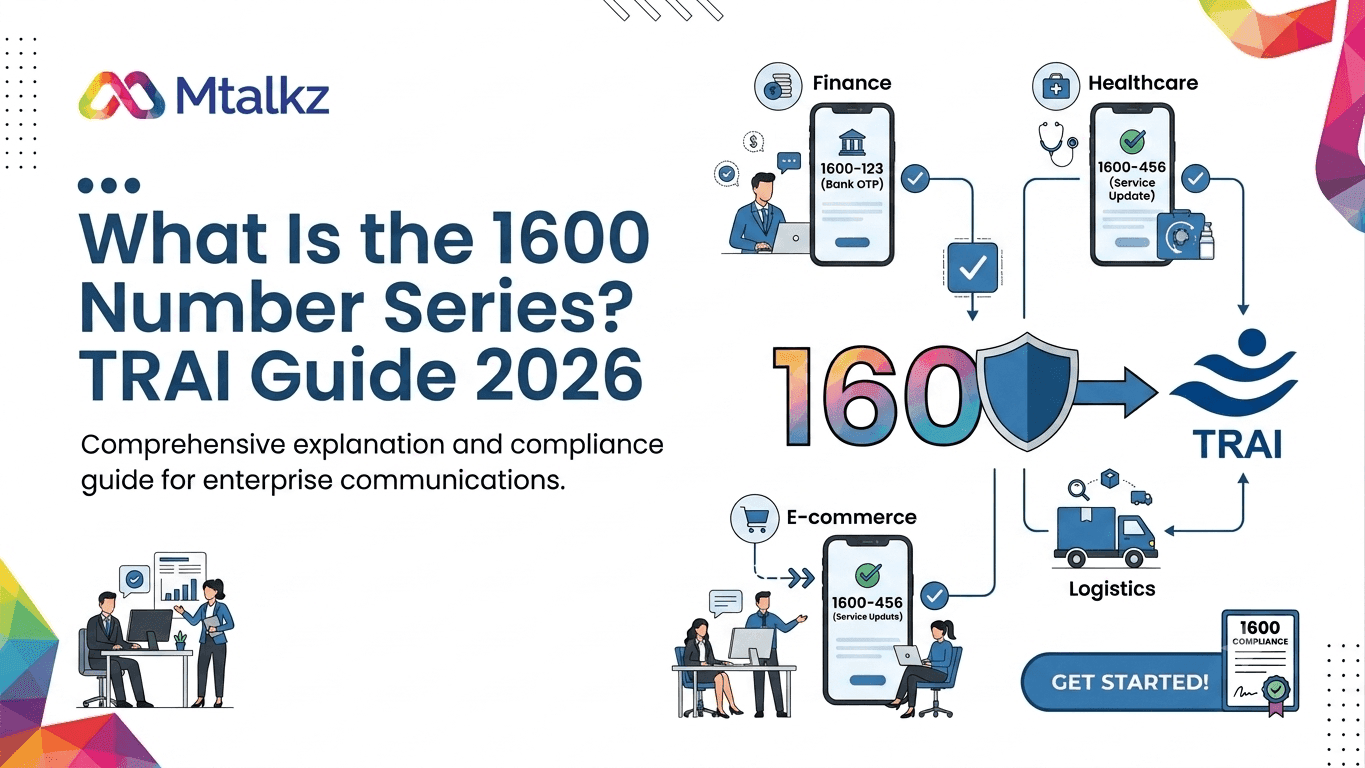
What Is the 1600 Number Series? Complete TRAI Guidelines Explained (2026)
TRAI's 1600 number series is mandatory for BFSI service & transactional calls. Explore guidelines, eligibility, compliance rules & migration steps for 2026
Abhishek Prakash
•Strategic sales leader with deep focus on customer relationship building and revenue growth. With over two decades of experience at corporates like IBM, Bharti Airtel, and Reliance Jio, driving excellence in enterprise profitability and competitive advantage.
As per Truecaller, India ranks as the fifth most spam-hit country in the world. There were 7.7 billion fraud calls recorded in 2025, while Truecaller identified and blocked 1,189 crore spam calls during the year. The numbers indicate that spam and fraud have become an undeniable part of day-to-day life.
Every day, thousands of people receive numerous calls claiming to be from banks, insurance companies, investment firms, or government departments. Some are genuine, while others want to gain your trust and steal your money or other personal details.
That’s why TRAI (Telecom Regulatory Authority of India) has introduced the 1600 number series to regulate telecommunication services. Banks and other financial institutions must use this number series for their official service and transactional voice calls.
Usually, fraudsters impersonate bank employees or insurance agents and call from regular 10-digit numbers. Since it seems like a regular, genuine call, users cannot find out it is a spam or fraud call.
Therefore, the ultimate objective of the 1600 series is to reduce spam calls and fraudulent activities through voice calls. People can identify it and don’t take the call. Let’s understand it in more detail.
What Is the 1600 Number Series?
The 1600 Number Series is issued by the Department of Telecommunications (DoT) to Banking, Financial Services and Insurance (BFSI) entities and government organizations. It is typically used for service and transactional voice calls and is regulated by TRAI.
In simple words, people get confused when they receive service and transactional calls from regular numbers and can’t identify important official calls. So, the DoT released a series of numbers starting with “1600.”
It means banks and your insurance agents will make any non-promotional calls (such as OTP verification calls, EMI reminders, KYC updates, policy renewal alerts) from the 1600 series.
The primary objective is to reduce fraud calls and enable citizens to identify legitimate calls originating from regulated financial institutions.
Why TRAI Introduced This 1600 Number Series
According to the data released by TRAI, spam calls in India have increased by 128% over the past three years. Even with artificial intelligence-based monitoring systems and stricter regulations, the problem is worsening and demands regulated action by our government.
In 2023, approx. 1.362 million complaints were recorded and increased to 3.109 million in 2025. It shows that fraudulent activities increase with the expansion of our digital communication ecosystem. That’s why the TRAI 1600 series has been introduced to improve customer trust and reduce fraud calls.
Under the Telecom Regulatory Authority of India Act, 1997, the 1600 phone number series must be adopted by RBI, SEBI, and PFRDA-regulated entities.
The core reasons behind the TRAI 1600 series regulation are as follows:
To enhance consumer trust:
With the introduction of the 1600 phone number series, customers will recognize that the call is not a fake or a spam call.
To reduce fraudulent activities:
By centralizing all legitimate BFSI service calls under a single number range, it becomes harder for imposters to disguise consumers as bank employees or insurance agents.
To advance traceability for spam calls:
Every number in the 1600 series will be linked to a verified business registered under a Distributed Ledger Technology (DLT) platform. It becomes easy to track the misuse immediately.
TRAI 1600 Series Guidelines: The Key Rules & Phase-Wise Deadlines
The 1600 number series guidelines are based on the direction issued under Section 13 of the TRAI Act, 1997. According to it, regulated entities can’t use a standard 10-digit number for service or transactional voice calls.
All entities are required to register with their Access Provider (telecom operator). They have numbers allocated before the applicable timeline. If they miss the deadlines, the entity will be treated as an unregistered telemarketer under TRAI's Unsolicited Commercial Communication (UCC) framework. Regulatory actions will be taken.
Core rules under TRAI 1600 series regulation
- 1600 numbers can be used only by regulated BFSI entities.
- Calls must be performed for service and transactional purposes.
- One cannot perform promotional or marketing activities with this phone number series.
- Numbers are allocated via telecom service providers.
- Before allocating the numbers, entities must be verified.
- All calls must comply with DLT regulations.
Purpose Behind the TRAI 1600 Number Series
- To curb promotional calls made in the guise of service and transactional calls.
- To differentiate BFSI entities from other callers and enable customers to make informed decisions about call acceptance.
- To prevent misuse of telecom resources
Timeline has been decided, and TRAI has issued a phase-wise implementation schedule under the 1600 number series regulations.
Key Provisions of the Direction
SEBI-Regulated Entities
- Mutual Funds and Asset Management Companies (AMCs) were required to complete adoption by 15th February, 2026.
- All Qualified Stockbrokers (QSBs) were required to complete adoption by 15th March, 2026.
- Other SEBI-registered intermediaries may voluntarily migrate to the 1600 series upon verification of their registration details.
RBI-Regulated Entities
- Commercial Banks (including Public Sector Banks, Private Sector Banks, and Foreign Banks) were required to onboard by 1st January, 2026.
- Large NBFCs (Asset size above 5000 crore), Payments Banks, and Small Finance Banks were required to onboard by 1st February, 2026.
- Remaining NBFCs, Co-operative Banks, Regional Rural Banks, and smaller entities were required to onboard by 1st March, 2026.
PFRDA-Regulated Entities
- Central Recordkeeping Agencies (CRAs) and Pension Fund Managers were required to onboard by 15th February, 2026.
Quick review of timelines for TRAI 1600 Number Series
Note: As of mid-2026, all phase-wise implementation deadlines for RBI, SEBI, PFRDA, and IRDAI-regulated entities have passed.
Who Can Use the 1600 Phone Number Series in India?
TRAI 1600 series is properly regulated to protect trust and reduce fraud. It is not for every telemarketer; it is reserved for specific entities.
Eligibility Criteria
As per TRAI’s direction, the 1600 number series is recommended for regulated entities and government organizations to reduce spam calls.
RBI-Regulated Entities
- Commercial banks
- Private banks
- Public sector banks
- Payment banks
- NBFCs (Non-Banking Financial Companies)
SEBI-Regulated Entities
- Mutual funds
- Asset management companies (AMCs)
- Stockbrokers
PFRDA-Regulated Entities
- Pension fund managers
- Central recordkeeping agencies
IRDAI-Regulated Entities
- Insurance companies
Government Organizations
- Public service communication bodies
- Regulatory updates and alerts
Important Limitations of TRAI 1600 Number Series
TRAI has mandated a 1600 number series for service and transactional calls by financial (BFSI) and government entities. They should be used for sending important transnational alerts and notifications and cannot be used for marketing purposes.
Key limitations are:
Outgoing calls only: This 1600 series is for verification calls or alerts. Customers cannot call the number back for further communication.
Not to be used for marketing: As per TRAI, the series is only used for service and transactional communications. For marketing, sales, and all promotional calls, the 140 series must be used.
Circle/State-wise allocation: These numbers are issued for a specific circle or state. Pan-India enterprises need to take multiple different 1600 numbers to operate in different regions.
Limited number availability: Based on their circles, each telecom operator is provided with a limited set of numbers. It creates challenges for large enterprises while handling high call volumes.
Not applicable to all enterprises: This TRAI 1600 number series is only for BFSI and government entities; not applicable to all enterprises.
System Readiness: To support the number series, businesses may need to upgrade their existing communication systems that include cloud telephony platforms, IVR system, and customer communication workflows.
Regulatory verification is mandatory: Complete verification and compliance with TRAI guidelines is a must before using the 1600 series.
1600 Series vs 140 Series: What Is the Difference?
Have you been wondering why TRAI introduced the 1600 series when we have the 140 series? Don’t be confused between the 1600 vs 140 number series. TRAI indeed introduced both numbers, but they serve completely different purposes.
In India, a 140-series number is used for commercial telemarketing and promotional calls. If you receive a call from this series number, you can assume it is for sales, marketing, or advertising. You may receive it if you like; otherwise, you can ignore it.
This 1600 phone number series is reserved for verified service and transactional calls. By creating different number series, the authority enables customers to identify the purpose of incoming calls and make wise decisions before picking up the call.
1600 Series vs 140 Series Comparison Table
How Businesses Can Get a 1600 Number
To make transactional or service-related voice calls, businesses need to get a 1600 series number under TRAI guidelines through their telecom service provider. It is not like a regular mobile or landline number. It is a specifically designed number series to allow customers to instantly recognize business calls and their purpose.
Before moving forward, you need to check if your calling activities fall under this category. As a trusted CPaaS provider, we help businesses complete the process without hassle. From understanding TRAI requirements and coordinating with telecom operators, we make a significant contribution in the entire process.
Step-by-Step Process to Get a 1600 Phone Number Series in India
Step 1: Check Your Eligibility
As discussed above, you should review the TRAI 1600 series guidelines and check whether you fall under the category of users who should use the number.
- RBI-Regulated banking institutions such as commercial banks, private banks, public sector banks, payment banks
- Non-Banking Financial Companies
- SEBI-Regulated Entities (Mutual funds, asset management companies, and stockbrokers)
- Pension fund managers and central recordkeeping agencies regulated by PFRDA.
- IRDAI-regulated insurance companies
- Government organizations
Step 2: Contact a Telecom Service Provider
If you are eligible to get this 1600 series number, you must connect with a TRAI-approved telecom operator. Discuss your requirements with the selected telecom provider and obtain the number in accordance with the TRAI 1600 series regulations.
Step 3: Complete the Registration Process
In this process, registration with a Distributed Ledger Technology platform is mandatory. Make sure to register yourself as a principal entity and map all services and transactional activities.
Step 4: Submit Necessary Documents
You need to submit the essential KYC documents for verification:
- Company registration certificate
- Business PAN card
- GST Number
- KYC details of the authorized signatory
- Regulatory approvals from RBI, SEBI, IRDAI, or PFRDA (whatever applicable)
Step 5: Update Your Communication Systems
Once you have been allocated a 1600 number series, you need to replace your old number with the new number. Integrate with your existing cloud telephony platform, IVR system, customer calling software, and EPABX.
Step 6: Make Allocation Within the Timelines
After discussions with various entities, TRAI shared the deadlines and ensured businesses would have enough time to meet them.
Step 7: Test Before Going Live
Before going live, perform end-to-end testing and ensure calls are routing correctly. It will help customers identify your new 1600 number instead of blocking it.
TRAI Compliance Requirements for Businesses for 1600 Series Number
Obtaining a 1600 series number is not enough. Businesses need to comply with TRAI's communication framework to avoid regulatory problems. It will help you maintain customer trust.
Some Important TRAI Compliance requirements are as follows:
- Use the 1600 series only for its predefined purpose defined by TRAI (service and transactional-related calls)
- Before making your call, you must be registered with the Principal Entity on a Distributed Ledger Technology (DLT) platform.
- Establish yourself as a verified caller identity so customers can trust you.
- Entities from the BFSI sector must follow phased deadlines
- Handle people’s data securely and maintain their confidentiality.
Can Users Block Calls From the 1600 Number Series?
Can users block the 1600 number series? The answer is still under discussion. This is because the main concern is not whether users block these numbers, but rather tagging, blocking, or filtering via apps/caller identification platforms under TRAI rules.
These numbers are reserved for verified service and transactional communication from regulated entities, such as banks and financial institutions.
TRAI has clarified that "any tagging, blocking or filtering of the calls originating from 1600 series numbers is not permitted under the Telecom Commercial Communications Customer Preference Regulation (TCCCPR)."
The decision also led to discussions between TRAI and Truecaller about how to identify unwanted calls. Truecaller argued that user feedback should also be considered when detecting spam communication.
According to Truecaller's data, 5.25 lakh users reported both 140 and 1600 series numbers as spam. The company also stated that users blocked around 4 lakh calls from the 140 series and 1.25 lakh calls from the 1600 series every day.
Note: Unlike the 1600 phone number series, users are also not allowed to tag or filter 140 series numbers, but can block them in the DND registry as per TRAI.
How MTalkz Can Help With Your 1600 Number Migration
As a reliable CPaaS service provider, we help enterprises use 1600 number services to offer high-delivery voice communication. We leverage Karix's robust infrastructure while delivering 1600-number solutions to our customers.
Our experience in BFSI communication enables us to deliver effective support to banks, NBFCs, and fintech companies for their enterprise voice communication. With years of industry exposure and technical expertise, we can help you with TRAI 1600 series migration.
Mtalkz Service Model
- Sourcing of 1600 number services.
- Handle integration, onboarding, and delivery.
- Single-window support and management.
- APIs and platforms enable seamless voice campaign execution.
As a third-party service provider, we help you adopt the 1600 number series under TRAI guidelines. From initial onboarding to complete implementation, our team provides the following customized solutions based on your requirements:
- End-to-end onboarding assistance
- Telecom operator coordination
- Cloud telephony expertise
- IVR and API integration
- Scalable infrastructure for bulk voice calls
- Compliance guidance
- Dedicated implementation support
Final Thoughts
TRAI has introduced the 1600 number series to protect consumers from fraud and misuse of telecom resources. We have the 140 number series for promotional calls. Still, the 1600 series is reserved for service and transactional calls by the Department of Telecommunications, exclusively for service, transactional, and informational calls from government bodies and financial institutions regulated by the RBI, SEBI, IRDAI, and PFRDA.
It helps customers distinguish the number from a regular number and know the purpose of the call. It also aims to fight the rise of spoofing and impersonation-based financial fraud. With this step, customers can determine whether the call is from a legitimate source and whether to take it.
FAQs
What is the 1600 number series?
In India, the 1600 phone number series is a dedicated phone number prefix designated for service- and transaction-related voice calls. It was introduced by TRAI for BFSI sector entities.
Why did TRAI introduce the 1600 number series?
TRAI 1600 number series was introduced to help consumers identify genuine business calls and make informed decisions before picking up any call. It improves customer trust in telecom communications and reduces spam calls.
Who can apply for a 1600 number?
A government organization or a Principal Entity regulated by the RBI, SEBI, IRDAI, or PFRDA can apply for a 1600 number series.
How is a 1600 number different from a 140 number?
The 1600 series is reserved for service or transactional calls, while the 140 series is used for promotional and telemarketing communications.
Can businesses continue using their existing phone numbers?
To comply with TRAI’s guidelines, businesses need to migrate the number used for service or transactional calls to a 1600 number series.
Will the 1600 number series completely stop spam calls?
No, we cannot say that exactly. The initiative is made to let customers know whether the particular number is a spam call or genuine. It helps to reduce spam calls but cannot completely stop them.
How to get a 1600 number?
To get a 1600 number series, you need to approach an authorized telecom service provider. Make sure to complete the required verification and onboarding processes. As a reliable CPaaS service provider, we can help you migrate your 1600 number series. Connect with us for more details.

