
Can RCS Messaging Be Used for Transactional Alerts Like OTPs and Delivery Updates in India?
Abhishek Prakash
•Strategic sales leader with deep focus on customer relationship building and revenue growth. With over two decades of experience at corporates like IBM, Bharti Airtel, and Reliance Jio, driving excellence in enterprise profitability and competitive advantage.
In today’s fast-moving digital world, communication has evolved beyond traditional SMS. Businesses are constantly searching for reliable, secure, and engaging channels to reach customers instantly. One of the latest advancements in this space is RCS messaging (Rich Communication Services). But can RCS be effectively used for transactional alerts like OTPs and delivery updates in India? The short answer is yes. However, understanding how it works, its benefits, and its compliance factors is crucial before implementation.
This article explores how RCS messaging fits into India’s digital communication ecosystem, how it compares with other channels like Bulk SMS, and why brands should consider this advanced messaging solution for seamless and secure customer engagement.
👉 Mtalkz can help you
Understanding RCS Messaging
RCS messaging is an upgrade to traditional SMS that allows businesses to send rich, interactive messages. It combines the reliability of SMS with the engaging features of chat apps like WhatsApp. With RCS, companies can send branded messages, images, buttons, and even carousels directly through a customer’s default messaging app—without needing a third-party application.
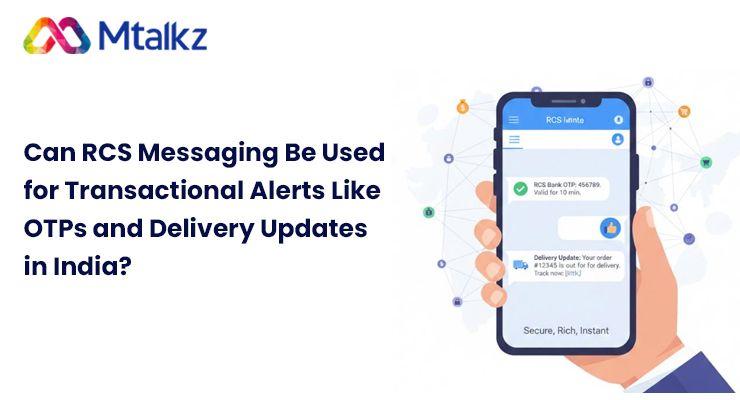
For example, instead of a plain text OTP, a bank can send a branded message with its logo, a verification code, and clickable options to complete authentication securely.
You can learn more about how this works through RCS messaging services offered by Mtalkz, which empower businesses to create rich and secure customer experiences.
Why RCS Messaging Is Suitable for Transactional Alerts
1. Enhanced Security
Transactional alerts like OTPs and delivery updates require a high level of security and trust. RCS messages are verified, meaning customers can see the sender’s business name, logo, and authentication badge. This prevents fraud and ensures users are interacting with legitimate businesses.
2. Real-Time Delivery and Read Receipts
Unlike traditional SMS, RCS supports delivery confirmations and read receipts, ensuring that critical messages like OTPs are not just sent but actually received and opened by users.
3. Interactive Elements
RCS allows businesses to include quick reply buttons, images, and links. For example, an eCommerce brand can send a delivery update with a “Track Order” button embedded directly in the message, creating a seamless user experience.
4. Cost Efficiency and Reach
While RCS is more advanced than SMS, it uses mobile data or Wi-Fi, making it cost-effective. With increasing smartphone penetration in India, RCS is becoming a practical and scalable solution for businesses of all sizes.
Comparing RCS with Other Communication Channels
Although RCS is emerging as a powerful communication tool, it’s important to understand how it complements other channels like Bulk SMS, WhatsApp Business API, Email Marketing Software, and IVR Testing Services.
1. RCS vs Bulk SMS
Bulk SMS remains a reliable method for sending alerts to a wide audience. It works on both smartphones and feature phones and is ideal for time-sensitive alerts. However, RCS enhances this experience by offering a richer, more interactive format. If you want to reach a mix of audiences across devices, combining Bulk SMS and RCS can offer the best results.
2. RCS vs WhatsApp Business API
WhatsApp Business API is another effective channel for two-way business communication. It’s widely adopted in India, and its conversational capabilities make it ideal for customer engagement and support. However, RCS integrates directly with the phone’s native messaging app, giving it an edge for OTPs and transactional alerts. Businesses can explore the WhatsApp Business API offered by Mtalkz to enhance their multichannel communication strategy.
3. RCS vs Email Marketing
Email Marketing Software is best suited for long-form content like newsletters, invoices, and promotions. It’s less effective for immediate transactional messages. RCS, on the other hand, ensures real-time delivery and visibility. Businesses can combine both for a complete communication strategy—RCS for instant alerts and Email Marketing Software for detailed updates.
4. RCS and IVR Integration
RCS can work hand-in-hand with IVR systems to provide multi-channel support. For example, after a customer completes a call via an IVR, they can receive a confirmation or OTP through RCS. Businesses can optimize their systems using IVR Testing Services to ensure flawless integration.
Regulatory Landscape of RCS in India
In India, all promotional and transactional messages are regulated by TRAI (Telecom Regulatory Authority of India). RCS messaging also follows these DLT (Distributed Ledger Technology) guidelines to prevent spam and ensure transparency.
For OTPs, financial transactions, and delivery alerts, RCS provides a verified and compliant communication method. Businesses must register their sender ID and templates through approved aggregators to maintain compliance.
Benefits of Using RCS for Transactional Messaging
1. Verified Business Profiles
Each RCS sender is verified, reducing spam and increasing customer trust.
2. Personalized Engagement
RCS allows personalized and visually appealing content, improving customer interaction rates.
3. Real-Time Analytics
Businesses get delivery reports and read receipts to monitor campaign performance accurately.
4. Seamless Integration
RCS can be integrated with existing systems like CRM, SMS gateways, and APIs, ensuring easy adoption.
The Future of Transactional Alerts in India
India is moving rapidly toward digital-first communication. With increasing smartphone usage and mobile internet penetration, RCS messaging is poised to become the new standard for secure and interactive transactional communication.
Brands that adapt early will enjoy better engagement rates, stronger customer trust, and higher operational efficiency. By combining RCS with other channels like Bulk SMS and WhatsApp Business API, businesses can create an omnichannel experience that keeps customers informed and connected.
Final Thoughts
RCS messaging represents the next generation of business communication in India. Its ability to combine the reliability of SMS with the interactivity of modern messaging makes it perfect for transactional alerts like OTPs and delivery updates.
If your business is ready to upgrade its customer communication and experience, Mtalkz can help you integrate RCS, SMS, WhatsApp, and email solutions into one seamless platform.
Explore how Mtalkz can help your business communicate smarter and faster — visit Mtalkz today.
FAQs
1. Can RCS messaging be used for OTPs in India?
Yes, RCS messaging is ideal for OTPs because it supports real-time delivery, read receipts, and verified sender IDs.
2. Is RCS messaging approved by TRAI for transactional use?
Yes, RCS follows TRAI and DLT regulations, making it compliant for transactional alerts.
3. Does RCS work without an internet connection?
RCS requires a data or Wi-Fi connection, but messages can fall back to SMS if needed.
4. How is RCS different from SMS?
RCS offers rich media, branding, and interactive elements that traditional SMS cannot provide.
5. Can small businesses use RCS for customer communication?
Yes, with partners like Mtalkz, even small businesses can easily adopt RCS for secure and engaging messaging.
6. Can RCS replace WhatsApp for business communication?
RCS and WhatsApp both serve unique roles; RCS is better for native phone messaging, while WhatsApp is great for conversational marketing.
7. How secure is RCS messaging?
RCS messages are verified and encrypted, making them secure for transactional communication.
8. What industries can benefit from RCS?
Banks, eCommerce, logistics, and service providers can all benefit from using RCS for transactional and promotional messages.

